

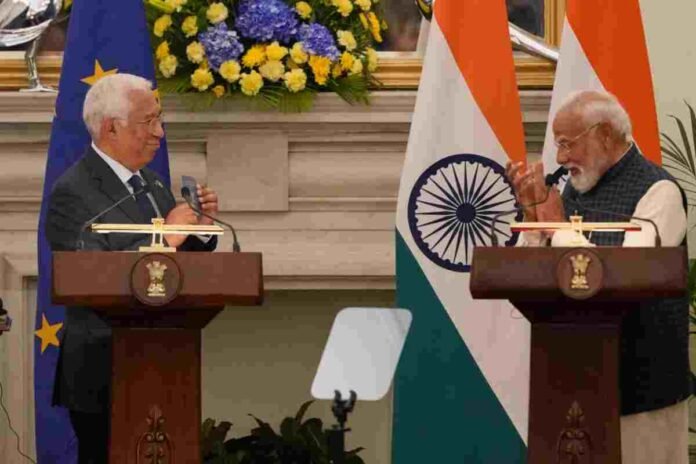


In a historic breakthrough for global trade, India and the European Union have finalized a landmark Free Trade Agreement (FTA) on January 27, 2026 — a pact leaders are already calling the “mother of all deals” that will reshape economic ties between two of the world’s largest economies and reverberate across global markets. The agreement, concluded after nearly two decades of negotiations, aims to eliminate or sharply reduce tariffs on the vast majority of goods traded between the regions, establishing a rules-based framework spanning nearly two billion people and about 25 percent of global GDP.
At the heart of this trade pact are significant changes in how vehicles and automotive products will be taxed when imported between the two economies — a development that has drawn attention from carmakers, consumers and investors alike. Under the terms of the agreement, India will dramatically slash its import duties on European-made cars, which had previously been among the world’s highest. For high-end luxury vehicles, tariff rates are set to fall from a peak of around 110 percent down to as low as 30 percent immediately under the deal, with phased reductions planned over time. These cuts will open India’s large passenger vehicle market — long dominated by domestic brands and high tariffs — to greater competition from leading European automakers such as BMW, Mercedes-Benz and Volkswagen.
For ordinary European-built cars falling under defined price categories, the agreement also introduces progressive tariff reductions that will gradually reduce auto duties down toward 10 percent over longer timelines, subject to quotas and implementation schedules agreed by both sides. After several years, tariffs on imported car parts are expected to be eliminated entirely, providing a longer-term boost to trade and supply-chain integration.
This tariff liberalization is particularly significant given India’s historically protectionist stance on automobile imports, with passenger vehicle duties previously ranging up to 110 percent. By agreeing to lower duties in a structured manner, India has signaled a broader commitment to liberalizing trade while balancing protections for its nascent electric vehicle sector and domestic manufacturers like Tata Motors and Mahindra & Mahindra — with electric vehicles excluded from initial tariff cuts for roughly five years to allow local EV production to mature.
Beyond automobiles, the FTA encompasses tariff reductions or eliminations on a wide range of goods, with nearly 97 percent of EU exports to India set to benefit from lower duties and 99 percent of Indian exports enjoying preferential access to the EU market. This includes sectors such as textiles, chemicals, marine products, machinery and intermediate goods critical to global value chains. European industries are expected to save around €4 billion annually in tariffs, and India anticipates a sharp rise in exports to its largest Western trading partner.
Trade officials on both sides have emphasized that the agreement goes beyond simple tariff cuts. It also includes provisions to enhance services trade, regulatory cooperation, investment flows, and professional mobility, creating broader opportunities for businesses and skilled workers. European Commission President Ursula von der Leyen described the pact as a “free trade zone of two billion people,” reflecting confidence that deepening ties will promote growth, competitiveness and strategic economic autonomy amidst an increasingly complex global trade environment.
The pact’s conclusion also carries geopolitical significance. It arrives amid heightened global trade tensions and shifts in economic alliances, partly influenced by protectionist policies in other major economies. By forging a more integrated trading relationship, India and the EU signal a strategic pivot toward multilateral cooperation and diversification of trade partners, reducing reliance on any single market.
However, not all sectors saw full liberalization. Sensitive areas such as certain agricultural products, dairy and cereals were excluded or retained protective measures to safeguard domestic industries on both sides. The agreement will still require ratification by the European Parliament, individual EU member states and India’s cabinet before it fully takes effect — a process expected to be completed in 2026 or early 2027.
For the automotive industry and global markets, the India-EU FTA represents a major realignment of trade opportunities. European automakers are likely to benefit from expanded market access and lower barriers, while Indian producers may gain stronger footholds in European markets for textiles, engineering goods and other exports. As tariff schedules unwind over the coming decade, consumers on both sides could see more competitive pricing and greater product variety, while companies benefit from deeper integration into international supply chains.
In sum, the India-EU trade agreement is not just a milestone in bilateral relations; it is a game-changing pact with broad economic, industrial and geopolitical implications — one that may define trade patterns well into the next decade.