

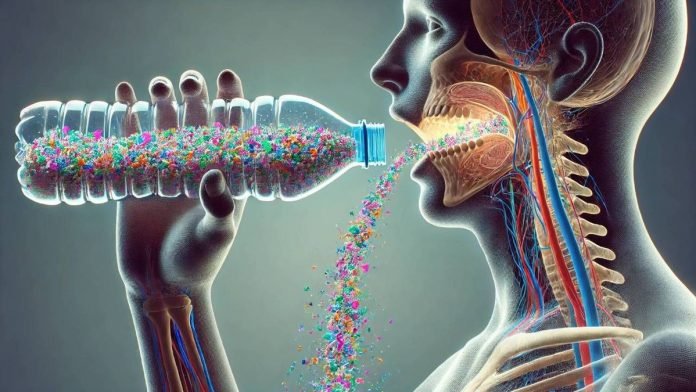


Deep within the walls of our arteries, where plaque silently builds toward heart attacks and strokes, a new intruder has taken up residence: tiny fragments of plastic, no bigger than a speck of dust. A groundbreaking study out of the University of California, Riverside, published November 17, 2025, in Environment International, reveals that everyday exposure to microplastics isn’t just tagging along—it’s accelerating the damage, and men bear the brunt. In a controlled experiment on mice, these pervasive pollutants slashed into male arteries far more aggressively than in females, igniting inflammation and plaque buildup without a single extra pound or cholesterol spike. As plastic pollution surges in our air, water, and food, this research flips the script on heart disease risks, urging a hard look at how our throwaway world is etching scars straight into our bloodstream.
Microplastics—bits smaller than 5 millimeters shed from bottles, bags, synthetic clothes, and tire wear—now infiltrate nearly every corner of life. Human studies have already spotted them in arterial plaques, with levels correlating to worse cardiovascular outcomes. But until now, the big question loomed: Do they cause the harm, or just hitch a ride on existing damage? Lead researcher Changcheng Zhou’s team dove in with LDLR-deficient mice, a breed engineered to mimic human atherosclerosis. For nine weeks, they dosed the animals orally with 10 milligrams per kilogram of polystyrene microplastics daily—doses mirroring what humans might gulp from contaminated seafood or sip through bottled water—while keeping everyone on a lean, low-fat chow.
The results hit like a warning siren. Male mice developed 2.5 times more plaque in their aortic arches and a staggering 3.8-fold increase in carotid arteries compared to unexposed controls. Fluorescent tracking showed the plastics burrowing into endothelial cells, the artery’s fragile lining, where they triggered a cascade of chaos: upregulated genes for inflammation, oxidative stress, and cell death, all hallmarks of accelerating atherosclerosis. Blood vessels stiffened, immune cells swarmed, and plaques grew unstable—primed to rupture and spark clots. Females? Largely spared. Their plaque areas barely budged, lipid profiles stayed steady, and vascular genes hummed along undisturbed. No obesity, no hypercholesterolemia—just sex-specific sabotage.
Zhou’s findings echo a growing chorus of alarms. A 2024 New England Journal of Medicine study tracked 257 carotid surgery patients and found microplastics in 58% of plaques, with those folks facing a 4.5-fold higher risk of heart attack, stroke, or death over 34 months. Men dominated that high-risk group, alongside smokers and diabetics, hinting at overlapping vulnerabilities like higher baseline inflammation or hormonal differences. Estrogen’s protective shield in females might blunt the plastics’ punch, while testosterone-fueled metabolisms could amplify uptake. Broader data from the American College of Cardiology ties microplastic hotspots in coastal communities to spikes in hypertension and stroke, with concentrations rivaling the toll of uninsured status or minority demographics.
So, how do these stealth invaders sneak in? Inhalation from urban dust, ingestion via tainted tap water (up to 240,000 particles per liter), or absorption through skin—pick your poison. Once inside, they don’t just float; they latch onto fats in plaques, stoking chronic low-grade fires that erode vessel walls. The UCR study rules out the usual suspects: No dietary tweaks, no weight creep. It’s the plastics themselves, rewiring cellular machinery to betray the heart.
The implications ripple far beyond lab cages. Cardiovascular disease claims 18 million lives yearly, and with global plastic production hitting 460 million tons in 2025, exposure is ramping up. Men, already edging out women in midlife heart risks, now face an environmental wildcard. Experts like Zhou stress prevention: Swap single-use plastics for glass or steel, filter drinking water rigorously, and vacuum synthetic rugs to trap airborne flecks. Diet tweaks—more fiber-rich plants to bind gut plastics—could help, too. But the real fix? Policy firepower: Bans on microbeads, incentives for biodegradable packaging, and global treaties to stem ocean dumps.
This isn’t abstract science; it’s a call to rethink our plastic dependency before it hardens our futures. Men, stock up on reusable gear and chat with your doc about baseline inflammation checks. Everyone else, join the purge. Our arteries can’t afford more squatters.